
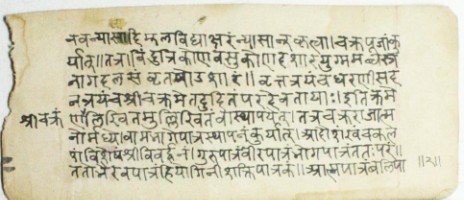
The Śrī Cakra is the most famous diagram in the goddess traditions of India — a geometry of nine interlocking enclosures said to contain the whole cosmos. Cakrapūjana is the manual for worshipping it, and this manuscript walks through the ritual step by step, from the first meditation to the final offering.
The goddess's pavilion
The ritual begins in the imagination, building the goddess's world with the precision of an architect.
One should meditate on the pleasure garden adorned with a network of flowering creepers. There, at the gateway with festoons, one should meditate on the pavilion of the Goddess, served by many crores of deities eager to serve, fragrant with the aroma of incense smoke rising from golden censers, resembling the risen sun, decorated with jewel staircases. In its center, one should meditate on the altar with corner spaces marked by lamp flames, kindled by camphor and fragrant wicks, with a canopy of jewel plates hanging from jewel pillars.
The geometry of the cakra
Then comes the diagram itself — its anatomy stated with geometric exactness.
The Śrī Cakra: in the bindu, triangle, eight-cornered figure, ten-cornered figure, pair of ten-cornered figures, fourteen-cornered figure, eight-petaled lotus, sixteen-petaled lotus enclosed, three circles — or the three residences of Dharaṇī — this Śrī Cakra of the Supreme Goddess is thus declared.
Point, triangle, octagon, decagons, fourteen-cornered figure, lotuses, circles — the cakra is a nested structure, each enclosure a layer of the goddess's presence, and the worshipper's hand traces the same path the mind has built.
Ritual as a complete architecture
Cakrapūjana is a window into a tradition where worship was an exact science — the right meditation, the right letters placed on the body, the right seats for the right goddesses, the right vessel. Nothing is left vague. Reading it, you see why the Śrī Cakra became the emblem of an entire school: it is a cosmos you can draw, and a ritual you can perform, both at once.