
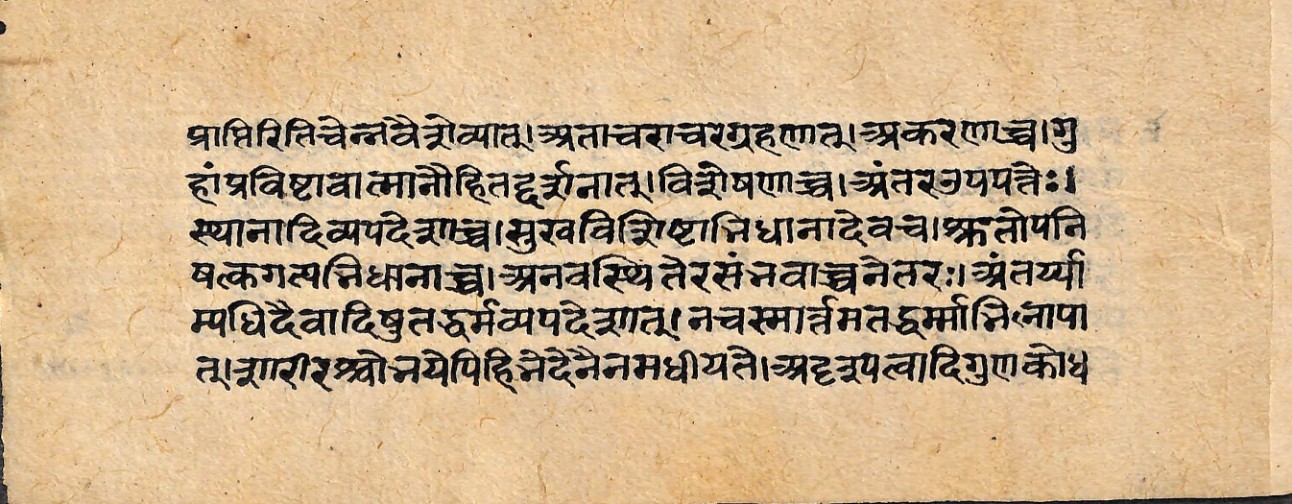
Some books begin with a bang. The Brahmāsūtra — the foundational text of Vedānta, attributed to Bādarāyaṇa — begins with four words: athāto brahmajijñāsā, 'now, therefore, the inquiry into Brahman.' This manuscript opens with those words and the chain of aphorisms that follow, the dense first moves of the entire Vedānta tradition.
The first aphorisms
The opening is a compressed engine of reasoning — every sūtra a claim, every claim an argument.
Now, therefore, the inquiry into Brahman. (That is the source) from which (are derived) the birth, etc. Because of being the source of the scriptures. But that (Brahman is known) from the agreement (of the Vedānta texts). (Brahman is not known) from the root 'īkṣ' (seeing), because it is not a word (denoting an agent).
In a handful of aphorisms, the text establishes the need for the inquiry, identifies Brahman as the source of the world, and defends the method by which Brahman is known — from the Upaniṣads, not from ordinary perception.
The soul and the Self
Later pages take up one of Vedānta's defining debates — whether the individual soul and the supreme Self are one or two.
If it is objected that the attainment is of the individual soul, no, because of the distinction. Because of the mention of the eater of the moving and the unmoving. And because of the context. Because the two selves are described as entering the cave.
The 'two selves entering the cave' is the Upaniṣadic image — the individual soul and the supreme Self dwelling in the same heart — and the sūtras argue carefully about whether they are the same.
A tradition in aphorisms
The Brahmāsūtra is the most commented-upon text of the Vedānta school — every major philosopher, from Śaṅkara to Rāmānuja, built a system on its sūtras. This manuscript, a copy of Bādarāyaṇa's text, preserves the source of all those systems: a book that begins with an inquiry, and never stops asking.