
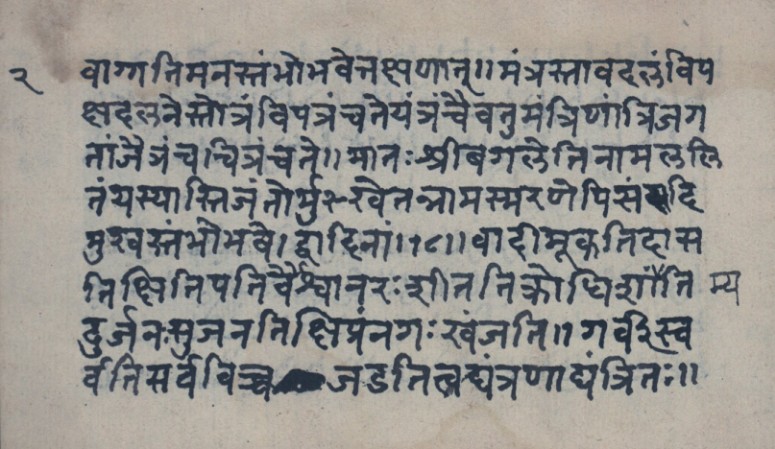
Some deities grant wealth. Some grant wisdom. Bagalāmukhī grants silence — to your enemies. This short tantric hymn, the Brahmāstra, is devoted to the yellow goddess who holds a mace in one hand and, in the other, the tongue she has seized from her opponent.
The goddess of the seized tongue
The hymn's iconography is precise and memorable.
I bow to the goddess who is not approached by enemies, who has the color of fresh gold, who is adorned with yellow garments, ornaments, and garlands, who holds a mace, and who has a tongue that is the enemy of the enemy. Taking the tip of her tongue in her left hand, the goddess torments the enemies; with her right hand, by the blow of her mace, I bow to her arm adorned with yellow garments.
She is stambhana personified — the power that arrests. And what she arrests, above all, is speech.
What the mantra does
The effects are catalogued with a confidence that is almost comic — and entirely serious in intent.
May the stambhana (paralysis) of speech and mind be for chatterers. The mantra alone is sufficient to destroy enemies. The speaker becomes mute, the servant of the earth becomes fire, the angry one becomes cool, the wicked one becomes good, the lame one quickly becomes a mountain (able to walk). Pride becomes humble, the all-knowing one becomes dull — by your mantra-empowered yantra.
Protection for a fragile world
Dated to Śaka 1755 and completed by the scribe Ananta Bhaṭṭa Bhāve, the manuscript places the hymn in its practical context: recited among enemies, in debates, when a king is enraged, during eclipses and at night. It is a text for the moments when words fail and something stronger is needed — a reminder that the tantric world took its protection seriously, and equipped its devotees with a goddess who could hold an enemy's tongue.