
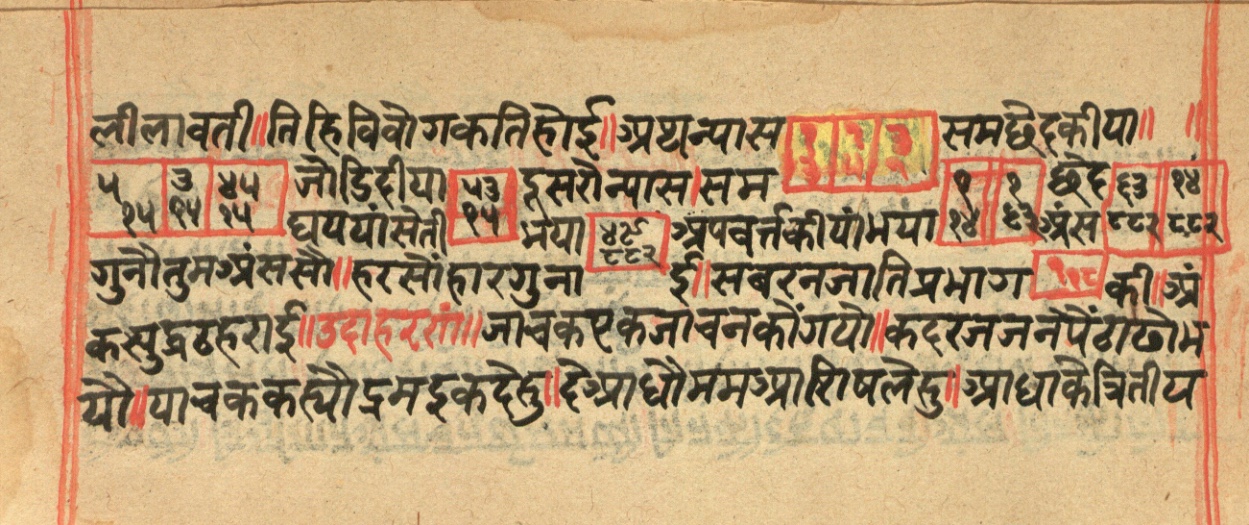
Bhāskara's Līlāvatī is famous as a Sanskrit classic — but what happens when the same mathematics is retold in the language people actually spoke? The Bhāṣālīlāvatī is exactly that: the Līlāvatī tradition in vernacular form, with rules explained in simple prose and dohās, so that arithmetic could be learned without Sanskrit.
The same math, a new voice
The methods are Bhāskara's — squaring by splitting numbers, extracting roots digit by digit — but the teaching voice is different.
Hold both numbers equally. Make them multiply each other. Make the square of that product — this consideration the sage Garga makes. Make the square of the last digit, then place the method upon it. Take the last digit and double it, place the preceding digit multiplied by it upon that. Removing the last digit, move the quantity.
The steps are walked through like instructions to a student standing beside you — do this, then this — rather than encoded in a verse to be unpacked.
Fractions with a common denominator
The manuscript works through fractions with the same hands-on clarity.
Common denominator was made. [5/15 | 3/15 | 4/15] Added together [12/15]. Second setting with common denominator [1/14 | 1/63]. Denominator 63, 14 [63/882 | 14/882]. Numerators with these became [77/882]. Reduction was made [11/126]. Multiply your numerator by the denominator. Denominator multiplied by denominator. Division of all classes.
What is striking is the worked arithmetic right in the text — the common denominators, the sums, the reductions all shown, the way a teacher would write them on a board.
Mathematics for everyone
And then there are the story problems — the young man who went to the forest, entered a cave, and gave away fractions of his wealth — carrying the Līlāvatī's love of narrative into the vernacular. The Bhāṣālīlāvatī is proof that the reach of Indian mathematics was not limited to Sanskrit scholars: the same procedures, the same puzzles, were being taught in the language of the market and the home.